
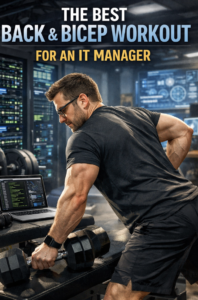
IT Managers carry two kinds of load every day. One is technical and strategic, the constant context-switching between people, priorities, incidents, budgets, and security. The other is physical, the hours spent seated, leaning toward screens, shoulders subtly rounding forward, neck craning, wrists locked into small repetitive motions. Over time, that posture tax shows up as tight pecs, sleepy mid-back muscles, stiff hips, and biceps that do plenty of keyboard work but not much meaningful strength work.
A great back and bicep workout for an IT Manager is built around the reality of the role. It has to be efficient, repeatable, joint-friendly, and focused on posture, strength, and resilience. It should also reinforce the muscle groups that support long sitting days, especially the lats, mid-back, rear delts, and the deep stabilizers around the shoulder blades. The biceps matter too, not as a vanity add-on, but as a functional partner to pulling strength and elbow health.
This plan delivers a complete back-and-biceps session that fits a busy schedule, strengthens the “anti-hunch” muscles, and leaves you feeling more capable in your body the same way you aim to feel capable in your systems.
Why This Workout Matches the IT Manager Life
A typical IT Manager day involves long stretches of seated work, frequent meetings, and problem-solving under time pressure. That combination tends to create a forward-shoulder posture and underactive scapular control. The smartest back training restores balance by emphasizing pulling patterns, scapular retraction and depression, and controlled eccentric work that builds durability without beating up the joints.
The biceps portion is deliberately structured to support the elbows and shoulders. Rather than endless curling, it uses a blend of neutral-grip and supinated work paired with strong back movements, which is a practical approach for people who already spend all day gripping a mouse and typing.
This matters even more in a climate where IT leaders are expected to stay ready for fast-moving security and AI shifts. Staying current on vulnerability exploitation alerts from agencies like CISA is part of the job, and so is staying personally resilient enough to respond well when the day turns chaotic.
Equipment Options and Setup
This workout works with a gym, a home setup, or a hybrid approach.
If you have a gym, use a cable station, pull-up bar, and dumbbells. If you train at home, a set of adjustable dumbbells and a resistance band can cover almost everything. A doorframe pull-up bar is optional but helpful.
Choose loads that keep form clean and controlled. The goal is to finish sets feeling challenged while still owning the last rep. The back responds best to precision and consistency, not reckless momentum.
Warm-Up and Activation
Spend 6 to 8 minutes preparing the shoulders, upper back, and elbows.
Start with a brisk walk or light rowing pace to raise body temperature. Follow with shoulder circles and gentle thoracic rotations to restore upper-back movement after sitting.
Then perform two activation movements.
Do band pull-aparts for 2 sets of 15 reps, keeping ribs down and shoulder blades moving back and down. Next, do scapular push-ups for 2 sets of 10 reps, focusing on smooth shoulder blade motion rather than arm bending.
This short warm-up is not filler. It signals the exact muscles you want to wake up, especially the mid-back and rear shoulder tissues that tend to go quiet during desk work.
Main Workout Structure
This session uses three blocks.
Block one builds the foundation with a vertical pull and a heavy row pattern. Block two builds thickness and scapular control. Block three finishes with biceps work that supports elbow health and grip endurance.
Rest periods are simple.
Use 60 to 90 seconds between sets for primary lifts, and 45 to 60 seconds between sets for accessory and biceps work. Keep transitions smooth and focus on quality reps.
Block One: Vertical Pull and Primary Row
Start with a vertical pull that strengthens lats and shoulder blade control.
Pull-ups are ideal, but lat pulldowns work perfectly. Choose the version that lets you keep the chest tall and shoulders away from the ears.
Perform 4 sets of 6 to 10 reps. Use a controlled lowering phase of about 2 seconds.
Next, move to a primary row.
Use a chest-supported dumbbell row, a seated cable row, or a one-arm dumbbell row with the non-working hand braced on a bench. The braced position is excellent for IT Managers because it lets you load the back while limiting low-back fatigue.
Perform 4 sets of 8 to 12 reps. Pause briefly with the elbow back, then lower under control.
Think about driving the elbow toward the back pocket rather than yanking with the arm. This cue keeps the back doing the work and keeps the biceps from stealing the rep.
Block Two: Posture Builder Superset
This block improves the muscles that keep shoulders back and stable.
First movement is a face pull, ideally on cables or a band. Pull toward the bridge of the nose, elbows high, then squeeze the upper back for a beat. This movement directly counters the rounded, screen-focused posture that shows up in long IT days.
Second movement is a straight-arm pulldown, done with a cable or band. Keep elbows mostly straight and pull down using the lats, finishing with shoulder blades down.
Perform 3 rounds of the superset.
Face pulls: 12 to 15 reps
Straight-arm pulldowns: 12 to 15 reps
This pairing strengthens the “support beams” of your upper body. It also teaches your shoulders to sit in a more stable position, which can make daily work at a desk feel less draining.
In parallel, it supports the kind of governance mindset many IT leaders are being pushed toward as regulators and agencies sharpen expectations around cybersecurity and AI risk controls. The SEC cybersecurity resources page is one example of how governance and controls are becoming a bigger part of the broader IT leadership landscape.
Block Three: Biceps Strength and Elbow-Friendly Volume
Biceps training should feel clean in the elbows and wrists. Choose grips that fit your joints.
Start with incline dumbbell curls or standing dumbbell curls. Incline curls are especially useful because they train the biceps through a longer range of motion and discourage swinging.
Perform 3 sets of 8 to 12 reps.
Next, use hammer curls. The neutral grip can be kinder to wrists and elbows, and it trains the brachialis and forearm support muscles that matter for grip endurance.
Perform 3 sets of 10 to 12 reps.
Finish with a high-rep cable curl or band curl.
Perform 2 sets of 15 to 20 reps with a strict, controlled tempo.
These biceps sets are enough to build strength and shape while still keeping the workout anchored in back development. Your back is the priority, your biceps are the supportive finisher.
For context and terminology, a straightforward definition of information technology and its management context can be found on Wikipedia’s Information technology page, which is a helpful baseline when you think about how broad the IT Manager role has become.
Cool Down and Desk-Day Reset
Finish with 3 to 5 minutes of downshifting.
Do a gentle lat stretch by holding a stable surface and sitting your hips back while reaching long through the arms. Then do a doorway pec stretch to undo chest tightness that contributes to rounded shoulders. End with slow nasal breathing to shift out of high-alert mode.
This is not about flexibility perfection. It is about recovery, and about closing the loop so you return to work feeling more open through the chest and upper back.
Progression Plan That Fits a Busy Schedule
Train this back and bicep workout 1 to 2 times per week.
If you do it once weekly, make it consistent and aim to add a small amount of weight or a rep or two each week on the first two blocks. If you do it twice weekly, keep the second session slightly lighter and focus on pristine form and extra control.
Progress without drama.
Add 5 pounds when you can complete the top end of the rep range across all sets with stable form. If you use bands, progress by stepping farther back, using a thicker band, or increasing reps.
Recovery matters, especially in high-stress IT environments where incident response and compliance pressure can spike. The growing attention to enforcement and accountability in cyber-related cases has been highlighted in outlets like Federal News Network, and that reality can translate into higher day-to-day stress. Training gives your body a constructive outlet for that load.
Conclusion
The best back and bicep workout for an IT Manager is one that respects time, supports posture, and builds the kind of strength that shows up in daily life. This plan prioritizes the big pulling patterns that restore balance after long hours seated, reinforces scapular control for healthier shoulders, and finishes with biceps work designed to strengthen without irritating the elbows and wrists.
Stick with it for eight weeks, keep reps controlled, and treat progression as a steady system upgrade rather than a one-time sprint. That same approach is already how strong IT teams operate, whether they are tracking evolving AI risk guidance from NIST or monitoring federal AI governance developments like the U.S. Treasury’s recent resources, including an AI lexicon, at Treasury.gov. When your body is supported, your leadership tends to feel steadier too, and the workday gets easier to carry.