
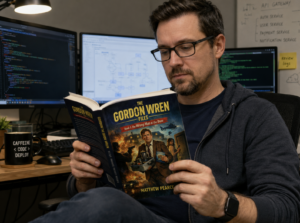
IT managers rarely get to enjoy the luxury of solving one problem at a time. A routine morning can begin with a software update, move into a network failure, and end with an executive demanding an immediate explanation for a system nobody in the company remembers purchasing. Somewhere in the middle, a printer will stop working for reasons that appear personal.
That is why The Gordon Wren Files: Book 1: The Wrong Man at the Door feels as though it was written for people who spend their working lives noticing what everyone else has missed.
Gordon Wren is not a polished intelligence officer with a collection of forged passports and a sports car hidden beneath a London townhouse. He is a middle-aged kitchen appliance salesman who arrives in the wrong place at precisely the wrong time. During a work trip connected to an international summit, ordinary service corridors, hotel deliveries, conference supplies, and premium household equipment begin pointing toward something far more dangerous.
The professionals surrounding him assume he must have advanced training. Gordon knows the truth. He has simply spent years watching people make expensive mistakes.
For IT managers, that may be the most believable superpower in modern fiction. 🖥️
Gordon Wren Solves Problems the Way IT Managers Do
The central pleasure of this British spy thriller series is not that Gordon suddenly becomes a fearless secret agent. It is that the habits he developed in an ordinary career become unexpectedly valuable in an extraordinary situation.
He notices packaging that does not match its contents. He questions routes that make no operational sense. He recognizes when an object is being handled differently from the way an ordinary employee would carry it. These details seem minor to everyone else because everyone else is looking for something dramatic.
IT managers understand that the important clue is often the detail nobody considered worth mentioning.
A failed login may be dismissed as user error until someone notices that it occurred from an unfamiliar location. A slow application may appear to be a performance problem until an experienced manager recognizes a pattern involving permissions, integrations, or an unapproved change. A delivery person entering the wrong hallway may look lost, while a manager accustomed to controlling physical and digital access may see a process failure.
The discipline of information technology management includes far more than maintaining computers. It involves aligning technology with organizational priorities while overseeing resources, staffing, planning, security, support, and change. Gordon’s world may involve kitchens, loading areas, and hotel corridors, but his method is familiar. He understands the system well enough to notice when something inside it does not belong.
Competence Is More Entertaining Than Invincibility
Traditional spy heroes tend to arrive fully equipped. They speak several languages, understand every weapon, recognize obscure poisons, and apparently receive extensive training in driving expensive cars through historic European cities.
Gordon has no such advantages.
His usefulness comes from competence, persistence, and irritation. He does not identify a conspiracy because he possesses classified intelligence. He identifies it because the criminals have arranged equipment badly, used an impractical route, and underestimated someone who knows how commercial operations actually work.
That distinction makes the story especially satisfying for IT professionals. Their most valuable work is often invisible. A reliable network does not attract attention. A carefully managed migration does not become a dramatic company story. A security problem prevented before it becomes an incident may never be known outside the IT department.
The U.S. Bureau of Labor Statistics description of computer and information systems managers reflects the breadth of the role. These managers help determine technology goals and direct the implementation of systems needed to meet them. In practice, that means understanding both technical details and the larger business environment in which those details matter.
Gordon operates in much the same territory. Other characters see boxes, hallways, appliances, staff entrances, and hotel procedures. Gordon sees dependencies. He sees where a process should lead, where it actually leads, and why the difference matters.
The Wrong Man at the Door Understands Operational Chaos
Every IT department has encountered a situation that began with someone saying, “It should be simple.”
A supposedly minor request turns out to involve an unsupported application, a former employee’s credentials, two outside vendors, an undocumented database, and a device installed during an office renovation six years earlier. By the time the problem reaches the IT manager, three departments have already developed conflicting explanations.
The Wrong Man at the Door builds its comedy and suspense from the same kind of escalation.
Gordon begins with a normal commercial assignment. He does not volunteer for an intelligence operation. He is pulled into one because the ordinary infrastructure surrounding an international event has been compromised. Service traffic, hotel operations, catering supplies, premium equipment, and delivery routes become part of a criminal system hiding in plain sight.
The situation grows increasingly absurd, but Gordon remains focused on practical details. That contrast gives the story its dry humor. The people with impressive titles keep searching for a sophisticated explanation. Gordon keeps pointing out that someone has put the wrong item in the wrong place.
IT managers live in the space between official explanations and observable reality. Policies may say one thing while systems do another. A diagram may show a clean network architecture while the actual environment contains years of emergency additions. A vendor may describe a seamless integration shortly before requesting administrative access and a Friday evening deployment.
Gordon’s refusal to be impressed by confident nonsense makes him an ideal hero for readers who have survived similar meetings.
The Story Rewards Pattern Recognition
Strong IT leadership depends on the ability to recognize patterns across systems, people, processes, and risk. A manager may not personally configure every server or investigate every security alert, but that manager must understand how individual events connect.
The NIST Cybersecurity Framework describes cybersecurity risk management through connected functions that include governance, identification, protection, detection, response, and recovery. The framework is designed to help organizations understand and improve how they manage cybersecurity risk rather than treating security as a collection of unrelated technical tasks.
Gordon applies a less formal version of the same thinking. He identifies what should be present, detects what is out of place, considers who benefits from the disruption, and responds using the limited resources available to him.
He is not brilliant because he knows everything. He is effective because he pays attention long enough to understand what the surrounding professionals have overlooked.
This makes the tension more convincing. Gordon cannot rely on unlimited resources or secret technology. His decisions grow from observation, memory, and experience. Each small inconsistency becomes part of a larger picture, just as an unusual support ticket, access request, or configuration change can become meaningful when viewed alongside other events.
Security Professionals Will Appreciate the Human Weaknesses
Technology may be complicated, but many security problems begin with ordinary human behavior. Someone trusts the wrong message. Someone holds a secure door open. Someone ignores an alert because it arrived during a busy afternoon. Someone assumes a person carrying equipment must belong in the building.
The Cybersecurity and Infrastructure Security Agency publishes guidance intended to help organizations manage cyber risk through preventative measures and practical security habits. That emphasis matters because even advanced controls can be weakened by rushed decisions, unclear responsibility, or misplaced confidence.
The criminals in Gordon’s world exploit similar weaknesses. They move through respectable environments by using the appearance of ordinary work. Supplies, uniforms, service entrances, delivery schedules, and professional confidence become camouflage.
Gordon is harder to fool because he understands what ordinary work actually looks like.
He knows how equipment should arrive. He knows how staff behave when they are genuinely responsible for an item. He knows which shortcuts are common and which ones are suspicious. His experience has taught him that people reveal their priorities through small movements and practical choices.
That is a useful reminder for IT managers. Security awareness is not limited to recognizing malicious code. It also requires understanding normal behavior well enough to identify the abnormal.
IT Managers Will Recognize the Frustration of Being Right Too Early
One of the recurring experiences of technical leadership is warning people before a problem becomes visible.
The IT manager explains that an unsupported system creates risk. The concern is acknowledged, added to a future agenda, and quietly forgotten. Months later, the system fails. The same people who postponed the replacement now ask why the department did not prevent the outage.
Gordon experiences a more dangerous version of that frustration. He notices inconsistencies before the people with authority understand their importance. Because his background appears ordinary, his observations are easy to dismiss. Only when events begin collapsing does everyone realize that the appliance salesman has been reading the environment more accurately than the trained professionals.
This is where the book’s comedy becomes especially sharp. Gordon does not enjoy being underestimated, but he is not eager to become admired either. He would prefer people to stop creating avoidable problems.
The IT governance resources published by ISACA emphasize management, communication, problem-solving, leadership, operations, risk management, and attention to detail. Those skills sound sensible on paper. In a real organization, they often require a manager to deliver unwelcome information to people who would rather continue with a convenient assumption.
Gordon’s competence is powerful because it is grounded in that same willingness to remain observant when everyone else has accepted the easier explanation.
The Humor Comes From Professional Recognition
The story is funny without abandoning its thriller structure. Its humor grows from misplaced confidence, organizational confusion, bad assumptions, status-conscious professionals, and Gordon’s increasingly strained attempts to explain obvious facts.
IT managers are likely to recognize these dynamics immediately.
There is the person who believes forwarding an email counts as resolving a problem. There is the executive who treats technical terminology as a ceremonial language. There is the professional who creates a complicated procedure because admitting confusion would be embarrassing. There is the manager who wants an immediate solution but becomes alarmed when told that the solution requires a decision.
Gordon moves through a spy crisis with the weary patience of someone who has already spent years dealing with customers, supervisors, delivery schedules, demonstrations, and expensive objects placed in unsuitable locations.
He does not need to become more sarcastic as the danger increases. The circumstances simply become more deserving of sarcasm.
That tone separates the book from darker espionage fiction. The stakes can rise without turning Gordon into a different person. He remains practical, annoyed, observant, and determined to prevent incompetent people from damaging equipment, disrupting operations, or possibly destabilizing Europe.
It Offers a Welcome Break From Real IT Manager News
IT managers need to stay informed. New security threats, artificial intelligence projects, cloud costs, workforce shortages, compliance requirements, vendor changes, and digital transformation initiatives compete for attention every week.
Publications such as CIO cover the changing expectations placed on technology leaders, including business alignment, security, budgeting, innovation, talent, artificial intelligence, and operational performance. The modern IT manager is expected to protect the organization, improve efficiency, support growth, reduce costs, manage vendors, explain technical risk, and remain calm while doing all of it.
After spending the day reading about those responsibilities, opening another serious management book may feel suspiciously similar to attending an additional meeting.
The Wrong Man at the Door offers something different. It gives IT managers the pleasure of watching practical competence receive the recognition it deserves, even when that recognition arrives in the least convenient form possible.
The book does not ask readers to study another framework or prepare for another organizational transformation. It lets them enjoy a hero whose greatest strengths are experience, skepticism, pattern recognition, and a refusal to accept operational foolishness as inevitable.
Gordon Wren Is the Spy Hero IT Managers Did Not Know They Needed
Gordon succeeds because he understands that systems are made from details. Routes matter. Packaging matters. Timing matters. Behavior matters. The person who knows how things normally work has an advantage when someone begins using those things for an abnormal purpose.
That is why he feels so familiar to IT managers.
They may not spend their evenings disrupting international conspiracies, but they regularly protect organizations by noticing problems before those problems become obvious. They translate confusion into action. They recognize patterns across departments. They keep operations moving while other people underestimate how much knowledge that requires.
Gordon turns those qualities into the foundation of a spy thriller.
He is not the most glamorous man in the building. He is simply the one paying attention.
Conclusion
The Gordon Wren Files: Book 1: The Wrong Man at the Door gives IT managers a rare kind of protagonist: a capable professional whose ordinary experience becomes more valuable than theatrical heroics.
Gordon Wren does not save the day because he possesses secret training. He survives because he understands processes, notices inconsistencies, questions weak explanations, and refuses to ignore a problem merely because someone important has declared everything under control.
The result is a fast-moving British spy adventure filled with dry humor, escalating danger, sharp dialogue, and the deeply satisfying sight of competence defeating chaos.
For IT managers who have ever solved a crisis nobody else fully understood, Gordon’s accidental transformation into an intelligence asset will feel less like fantasy and more like professional recognition. 🔐